 Faculty of Art
Integrated Community Media Learning
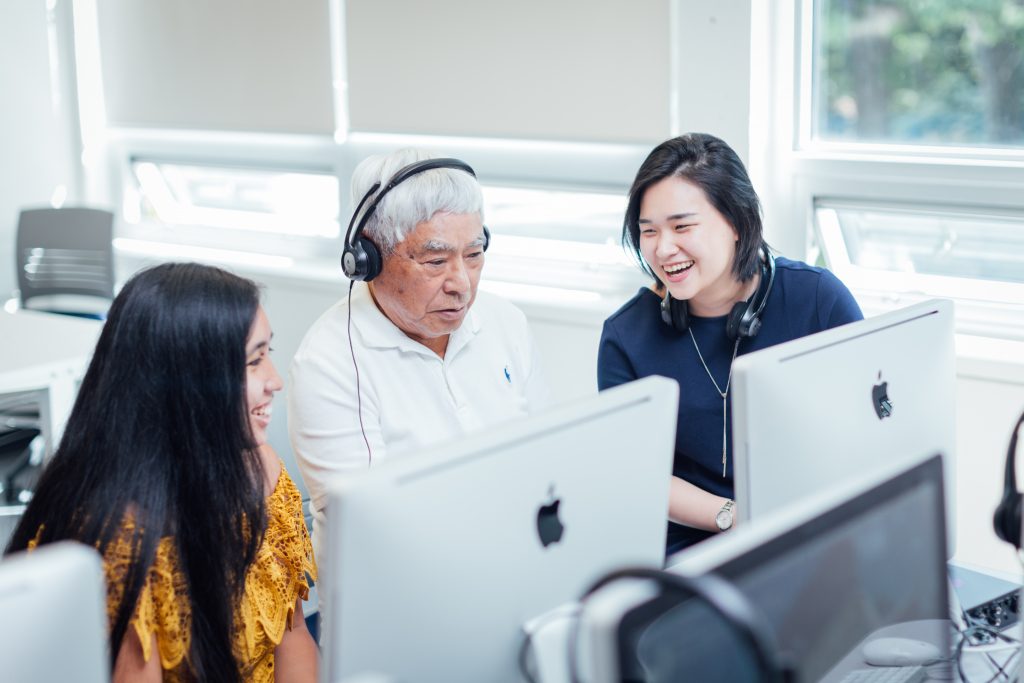
ACAM is committed to support student participation in the co-creation of knowledge with community members and knowledge holders. To achieve this goal, ACAM has been building and developing a curriculum infrastructure that facilitates a flexible learning environment for students to collaborate with communities through digital media production.
Over the past four years, with the support from Rogers Multicultural Film Production Program and UBC’s Teaching and Learning Enhancement Fund, ACAM has implemented mini-media production units in several of its affiliated courses, and developed a core course–ACAM350–dedicated to community-based media project. These piloting initiatives have generated impressive learning outcomes and benefits, including:
- Student films being featured at the Vancouver Asian Film Festival: Radicalizing Intimacies (2014); Cantonese: Passing (2015); Under Fire (2016); and Flagged (2017)
- Collaboration with Richmond Museum to showcase student films in the museum’s exhibit Our Journeys Here
- Student-led multimedia projects that help to enhance public understanding of the historical and cultural significance of Vancouver’s Chinatown—for example, Angela Ho’s Chinatown Sound Map and Christy Fong’s Disappearing Moon Cafe virtual field trip project
- Community screenings of student films that generated sustained conversations within and beyond the university
- Students’ acquisition of portable skills in communication and multimedia production
- Students’ development of critical media literacy, leadership, and community partnership
Join the Community!
Join the ACAM community by being part of the crew! Fill out the following form if you would like to get more involved with ACAM and volunteer at one of our many events throughout the year. We look forward to meeting and working with you!
ACAM447
Students who are interested in investigating a specific topic or research project in-depth are encouraged to undertake a directed studies course or self-directed seminar through ACAM_V 447. To apply for this seminar, students have to provide a rationale for how and why their chosen topic cannot be accommodated within a regularly scheduled course; to develop a reading list around the chosen topic; and to design appropriate assignments and assessment rubrics to evaluate their learning outcomes. For more information on how to apply for ACAM_V 447, please download the application form: MS Word | PDF.
Past ACAM_V 447 seminar(s)
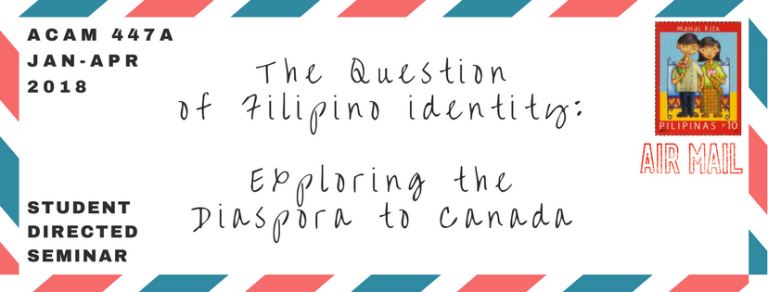
In 2018W, ACAM student and student engagement coordinator Phebe M. Ferrer hosted ACAM447A, a self-directed seminar exploring Filipino identities in diaspora. Her course invited students to learn and engage with the Filipino diaspora and communities in Canada, through an investigation and deconstruction of Filipino identity. Using a transnational theoretical framework, the course encouraged students to critically analyze the different social constructions of Filipino identity, based on migration, history, colonialism, politics, and other themes. Some examples of the topics covered in class include the Live-In Caregiver Program and the construction of the Filipina as a nanny; the integration of Filipino youth into Canadian high schools; the function of cultural organizations in building community; mixed and liminal identities, particularly of Filipino youth; and looking at the Filipino diaspora through a Queer and LGBTQ+ lens.
See other featured courses.
ACAM350

Taught by ACAM faculty and filmmaker Alejandro Yoshizawa, ACAM_V 350-001 – Asian Canadian Community-Based Media offers an introduction to techniques and practices of digital media production within the context of ethical community engagement.
Students enrolled in this course are expected to produce a short film on topics and issues pertinent to local Asian Canadian communities in Vancouver. Through readings and discussions focusing on topics including race and representation, media and technology, oral history, deep listening, and the ethics of community-based research, this course encourages students to critically reflect on their participation in filmmaking as a tool for community engagement. To showcase the course’s teaching and learning outcomes, and to facilitate broader conversations around issues explored in student films, a public screening will be held at the end of the term.
Beyond the scope of the course, our student films produced through this course have consistently been featured in the annual Vancouver Asian Film Festival: Radicalizing Intimacies by Stephanie Fung and Joanna Yang (2014); Cantonese: Passing by Elizabeth Cheong and Lisa Lee (2015); and Under Fire by Christy Fong and Denise Fong (2016); and Flagged by Mimi Nguyen (2017).
See other featured courses.
ACAM320A
To mark the 75th anniversary of the Japanese Canadian Internment, the Asian Canadian and Asian Migration studies program offered a special topics course, ACAM 320A: The History and Legacy of Japanese Canadian Internment, in January 2018. This course was co-taught by Mary Kitagawa and Professor John Price.
From 1941 to 1949, Japanese Canadians faced uprooting, incarceration, and dispossession: a defining instance of racial injustice in Canadian history. This course examines the histories, effects and legacies of the Japanese Canadian internment experience in the context of First Nations dispossession, anti-Asian racisms and contemporary struggles for minority and migrant rights. Participants will engage with community elders and activists and be encouraged to undertake community-based research. This course is being offered on the 75th anniversary of the uprooting and the 30th anniversary of redress.
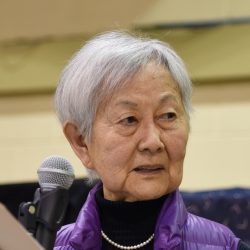 Mary Kitagawa was born on Salt Spring Island where she lived until the uprooting. After her father’s arrest, her mother and their five children were sent to Hastings Park, Greenwood, Magrath, Alberta, Popoff, Bay Farm, Slocan, Rosebery, New Denver, Magrath and Cardston, Alberta. She graduated from Cardston High and went on to Trinity College, University of Toronto. At UBC, she received her secondary teaching credential and taught at Kitsilano Secondary. She and her husband Tosh belonged to the Greater Vancouver JCCA Human Rights Committee for 23 years. In 2006, they were involved in the renaming of the Howard Charles Green building to the Douglas Jung building in downtown Vancouver. In 2008, they began lobbying for UBC to give honorary degrees to the 76 Japanese Canadian students who were expelled from UBC in 1942. Success was achieved in 2012 when UBC held a special congregation for those students, digitized historical documents pertaining to their lives, and created a new minor degree in the Faculty of Arts, the Asian Canadian and Asian Migration Studies Program. Mary is on the Community Council of the Landscapes of Injustice project at the University of Victoria. Mary and Tosh continue to educate the public by speaking out about Japanese Canadian history and social justice.
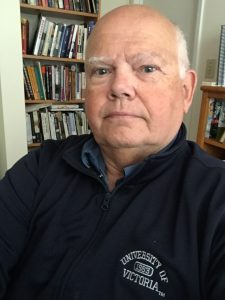 John Price is Professor of Pacific and Asian Canadian history at the University of Victoria. He moved to Japan at the age of 18 and, after returning to Canada, did his PhD at UBC. He is the author of Japan Works: Power and Paradox in Postwar Industrial Relations (Cornell University Press), Orienting Canada: Race, Empire and the Transpacific (UBC Press), and a recent working paper, “Seventy-Five Years is Long Enough: Will the BC Government Finally Acknowledge and Address Its Role in the Uprooting of Japanese Canadians?” He currently directs the research project, “Asian Canadians on Vancouver Island: Race, Indigeneity and the Transpacific,” funded by the Social Sciences and Humanities Research Council of Canada, and is completing two new works: Searching for Victoria, a biography of Victoria Chung, the first Asian Canadian to graduate from University of Toronto Medical School, and Beyond White Supremacy, a history of Asian Canadians and decolonization in Canada.
See other featured courses.
New course! ACAM 320A: History and Legacies of Japanese Canadian Internment
The Asian Canadian and Asian Migration studies program is pleased to offer ACAM 320A: Histories and Legacies of Japanese Canadian Internment, in January 2018. This course will be co-taught by Mary Kitagawa and Professor John Price.
From 1941 to 1949, Japanese Canadians faced uprooting, incarceration, and dispossession: a defining instance of racial injustice in Canadian history. This course examines the histories, effects and legacies of the Japanese Canadian internment experience in the context of First Nations dispossession, anti-Asian racisms and contemporary struggles for minority and migrant rights. Participants will engage with community elders and activists and be encouraged to undertake community-based research. This course is being offered on the 75th anniversary of the uprooting and the 30th anniversary of redress.
Mary Kitagawa was born on Salt Spring Island where she lived until the uprooting. After her father’s arrest, her mother and their five children were sent to Hastings Park, Greenwood, Magrath, Alberta, Popoff, Bay Farm, Slocan, Rosebery, New Denver, Magrath and Cardston, Alberta. She graduated from Cardston High and went on to Trinity College, University of Toronto. At UBC, she received her secondary teaching credential and taught at Kitsilano Secondary. She and her husband Tosh belonged to the Greater Vancouver JCCA Human Rights Committee for 23 years. In 2006, they were involved in the renaming of the Howard Charles Green building to the Douglas Jung building in downtown Vancouver. In 2008, they began lobbying for UBC to give honorary degrees to the 76 Japanese Canadian students who were expelled from UBC in 1942. Success was achieved in 2012 when UBC held a special congregation for those students, digitized historical documents pertaining to their lives, and created a new minor degree in the Faculty of Arts, the Asian Canadian and Asian Migration Studies Program. Mary is on the Community Council of the Landscapes of Injustice project at the University of Victoria. Mary and Tosh continue to educate the public by speaking out about Japanese Canadian history and social justice.
John Price is Professor of Pacific and Asian Canadian history at the University of Victoria. He moved to Japan at the age of 18 and, after returning to Canada, did his PhD at UBC. He is the author of Japan Works: Power and Paradox in Postwar Industrial Relations (Cornell University Press), Orienting Canada: Race, Empire and the Transpacific (UBC Press), and a recent working paper, “Seventy-Five Years is Long Enough: Will the BC Government Finally Acknowledge and Address Its Role in the Uprooting of Japanese Canadians?” He currently directs the research project, “Asian Canadians on Vancouver Island: Race, Indigeneity and the Transpacific,” funded by the Social Sciences and Humanities Research Council of Canada, and is completing two new works: Searching for Victoria, a biography of Victoria Chung, the first Asian Canadian to graduate from University of Toronto Medical School, and Beyond White Supremacy, a history of Asian Canadians and decolonization in Canada.
OCT 10: UBC Day of Learning
UBC Day of Learning
Envisioning our future at the 75th Anniversary of Japanese Canadian Internment
On Tuesday, October 10, 2017, UBC will host a Day of Learning to commemorate the 75th anniversary of Japanese Canadian internment and the 5th anniversary of the UBC Honorary Degree Ceremony for the 76 Japanese Canadian students expelled in 1942.
Through a series of panels and workshops, the Day of Learning will explore past and present societal themes of xenophobia, racism and discrimination, from the removal of indigenous peoples, to the incarceration of over 21,000 Japanese Canadians in 1942, and the rise of Islamophobia today. Full schedule of events available here. All events listed are open to UBC alumni, students, staff, faculty, and community members.
Everyone is welcome to register for any event(s), free of charge. Register here.
Jim Wong-Chu (1949-2017)
The faculty, staff, and students of the Asian Canadian and Asian Migration Studies Program are deeply saddened by the passing of activist, organizer, writer, and poet Jim Wong-Chu on July 11, 2017.
Born in Hong Kong, Jim came to Canada in 1953 as a paper son. He studied photography and design at the Vancouver School of Art (now Emily Carr University of Art + Design) from 1975-1981 and also studied Creative Writing at UBC from 1985-1987. As one of the main founders of the Asian Canadian Writer’s Workshop, he was instrumental in creating its magazine, Ricepaper, and establishing its Emerging Writer Award. He also helped found the Vancouver Asian Heritage Month Society/explorAsian and literASIAN: A Festival of Pacific Rim Asian Canadian Writing. His photography and poetry have been widely anthologized and he is the author of Chinatown Ghosts, a collection of poetry, and co-editor of the groundbreaking anthologies Many-Mouthed Birds: Contemporary Writing by Chinese Canadians, Swallowing Clouds: An Anthology of Chinese-Canadian Poetry, and Strike the Wok: An Anthology of Contemporary Chinese Canadian Fiction.
Jim’s special gift was his ability to knit together diverse communities from grassroots community activists to university researchers across multiple generations. Endlessly curious about diasporic histories, he was always concerned about encouraging and supporting the current and future generations of writers and artists. He donated his papers to UBC’s Rare Books and Special Collections in 2013, creating one of the most valuable archival collections available on Asian North American culture. When the ACAM was founded in 2013, he was an early supporter and regularly attended and spoke at its events.
ACAM would like to extend our sincere condolences to Jim’s family and friends. He is deeply missed.
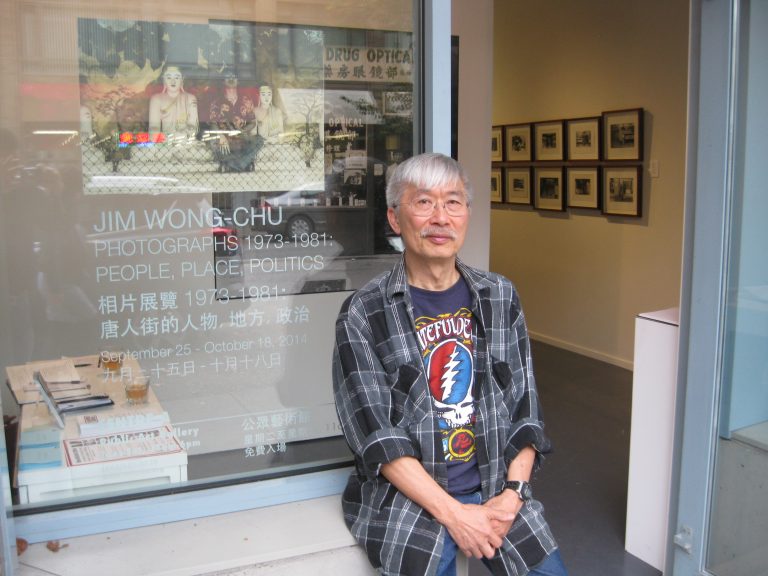
Jim Wong-Chu at Centre A
For more information: https://www.asiancanadianwiki.org/w/Jim_Wong_Chu
“Photo-Poetics / Photo-Politics: Visualizing Social Transformation”, a panel discussion with Jim Wong-Chu, Jack Jardine and Shelly Rosenblum moderated by ACAM faculty member Glenn Deer. Centre A, October 16, 2014. https://ikblc.ubc.ca/visual-and-performing-arts/photopoetics-2/
“Asian Canadian Studies with Terry Watada, Jim Wong-Chu, and Glenn Deer” panel discussion. Irving K. Barber Learning Centre, November 27, 2014. https://ikblc.ubc.ca/news/terrywatada/
More information about the Jim Wong-Chu fonds at UBC Rare Books and Special Collections can be found here: http://rbscarchives.library.ubc.ca/index.php/jim-wong-chu-fonds
Tyler Mark (BA, Geography)
Tyler Tadao Taiming Mark is graduating with a B.A. in Geography and a minor in Asian Canadian and Asian Migration studies. Born and raised in Vancouver, Tyler continues to learn what it means to be a Chinese-Japanese-Canadian diaspora on these unceded Coast Salish territories but is thankful to the ACAM community for providing an interdisciplinary space for critical conversations to take place. Working as the program’s communications coordinator, Tyler has had the privilege to be warmly welcomed into so many communities. He is fortunate to have had all the amazing lived experiences of mentors, professors, peers, and friends over the past five years. Tyler will be continuing his studies as a Masters student, Fall 2017, at UBC’s School of Community and Regional Planning.
ACAM 10: Our Alumni in 2025
What have you been up to since graduation?
I currently work as an urban planner for the City of Vancouver.
What have you learned from your ACAM experience that you still carry today?
Through the courses and opportunities to study abroad, I learned the importance of community connection. This has translated to commitment to community, invaluable friendships and continuous learning.
How has your ACAM experience equipped you for the challenges and opportunities you’ve encountered in exploring and developing your career?
I feel that ACAM gave me the tools to articulate my lived experiences into a skillset. This has allowed me to ground my lived experiences into my profession.
